
ETFs Explained: Investing, Averaging and Franking Credits
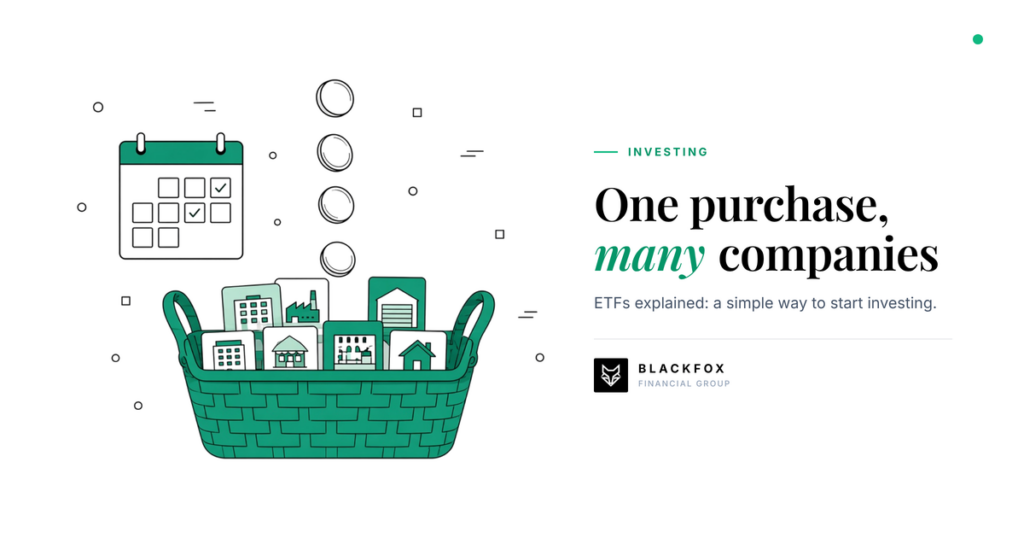
ETFs explained: a simple way to start investing
Exchange traded funds, or ETFs, have become one of the most popular ways for Australians to invest in shares. They’re simple to buy, you can start with a modest amount, and one purchase can spread your money across hundreds of companies. Here’s how they work, how regular investing smooths your buying price, and why franking credits matter at tax time.
What is an ETF?
An ETF is a managed fund that trades on a stock exchange, such as the ASX. When you invest, you buy units in the fund. The fund pools your money with other investors’ money, and the fund manager invests it.
ETFs can hold Australian or international shares, bonds, property, cash or commodities. Most Australian ETFs are passive: they aim to track an index, such as the S&P/ASX 200, rather than have a manager pick investments.
You don’t own the underlying shares directly. You own units in the ETF, and their value rises and falls with the assets the fund holds. Your return comes from any change in that value plus the income (distributions) the fund pays out.
How to invest in ETFs
Because ETFs are listed on the stock exchange, you buy and sell them the same way you buy shares:
- open an account with a stockbroker or online share-trading platform
- search for the ETF by its ASX code
- place a buy order during trading hours and pay brokerage on each trade.
Before you invest, read the ETF’s product disclosure statement (PDS), which explains what the fund invests in, its fees and its risks.
Diversification with a small amount
Diversification means spreading your money so one company having a bad year doesn’t sink your portfolio. Doing that with individual shares takes a lot of money, because you’d need to buy dozens of companies and pay brokerage on each.
An ETF does the work for you. A single purchase of a few hundred dollars in an ETF that tracks a broad index gives you a small slice of every company in that index. On the ASX, your first purchase of any share or ETF generally needs to be at least $500, although some platforms work differently.
Diversification reduces the risk of any one company hurting you, but it doesn’t remove market risk. If the whole share market falls, a broad ETF will fall with it.
Fees and risks to keep in mind
ETFs are often lower cost than unlisted managed funds, but they’re not free:
- Management fees. Each ETF charges an ongoing fee, often called the management expense ratio (MER). It’s shown as a percentage a year and is taken out of the fund, so you won’t see a bill, but it reduces your return.
- Brokerage. You pay brokerage each time you buy or sell.
- Market and sector risk. Your investment can fall in value. ETFs focused on one sector, country or theme can swing more than a broad index.
- Currency risk. ETFs that hold overseas assets are affected by exchange rates.
- Complex ETFs. Some use borrowing, short selling or derivatives, which adds risk.
Whose name should it be in?
Before you buy your first ETF, decide whose name it should be in. In our earlier article, Whose name should your investment be in?, we compared holding investments in your own name, joint names, a lower-earning spouse’s name, a family trust, a company or an SMSF. The right choice can affect the tax on your distributions and gains for decades, and changing it later can trigger capital gains tax. It’s worth getting right at the start.
Dollar cost averaging
Dollar cost averaging means investing the same amount at regular intervals, for example every month, rather than all at once. When prices are low, your money buys more units. When prices are high, it buys fewer. Over time this smooths out the price you pay and takes the guesswork out of trying to pick the right day to buy.
An example (illustrative only, with made-up prices). Priya invests $1,000 in the same ETF at the start of each month for four months. Brokerage is ignored for now.
- Month 1: price $20.00, buys 50 units
- Month 2: price $25.00, buys 40 units
- Month 3: price $12.50, buys 80 units
- Month 4: price $20.00, buys 50 units
Priya has invested $4,000 and owns 220 units. Her average cost is about $18.18 a unit ($4,000 ÷ 220), which is lower than the average of the four prices ($19.38). That’s because her fixed $1,000 bought more units when the price was low.
Being balanced about it:
- Dollar cost averaging doesn’t guarantee a profit or protect you from losses if prices keep falling.
- If prices rise steadily, investing a lump sum at the start would have bought more units.
- Brokerage matters with small, frequent buys. At, say, $10 a trade, Priya’s four buys cost $40, or 1% of what she invested. A single $4,000 purchase would cost $10.
Its real strength is habit: a regular amount makes investing automatic and keeps emotions out of it.
Franking credits: why Australian dividends can be tax effective
When an Australian company pays tax on its profits and then pays you a dividend, it can attach a franking credit for the tax it has already paid. You get credit for that tax in your own return, so the same profit isn’t taxed twice.
ETFs that hold Australian shares pass franked dividends through to investors. Your ETF’s annual tax statement shows your franking credits, and most ETFs pre-fill them in your tax return.
How it works (illustrative only). A company with a 30% tax rate pays you a fully franked dividend of $700, with a $300 franking credit attached. You include $1,000 in your taxable income (the $700 plus the $300 credit, called the grossed-up amount), pay tax on it at your rate, and then subtract the $300 credit.
Here’s the result at different tax rates, using 2026–27 resident rates. The figures exclude the 2% Medicare levy, which would add $20 for most people who pay it.
- Nil tax rate (total taxable income under $18,200): tax $0. The $300 credit is refunded.
- 15% rate: tax $150. The $300 credit covers it and $150 is refunded or reduces tax on other income.
- 30% rate: tax $300. The credit covers it exactly, so there’s nothing more to pay.
- 37% rate: tax $370. You pay $70 more.
- 45% rate: tax $450. You pay $150 more.
- Super fund in accumulation phase (15%): tax $150. The extra $150 reduces the fund’s other tax or is refunded.
- Super fund in retirement phase (0%): tax $0. The full $300 is refunded to the fund.
Excess franking credits are refundable to individuals and complying super funds, which is why they’re so valuable for retirees, lower-income investors and super funds. Companies can’t get a refund of excess credits.
The 45-day rule in simple terms. To claim franking credits, you generally need to hold the shares or units “at risk” for at least 45 days, not counting the days you buy and sell. Most small investors don’t need to worry about this, because the rule doesn’t apply if your total franking credits for the year are under $5,000. That’s roughly $11,667 of fully franked dividends.
When you sell
Selling ETF units is a capital gains tax (CGT) event, and ETF distributions can include capital gains too. Keep records of every purchase, including reinvested distributions.
The CGT rules are changing. From 1 July 2027, for individuals, trusts and partnerships, the 50% CGT discount will be replaced by indexation of the cost base for inflation, plus a 30% minimum tax on capital gains. Gains built up before 1 July 2027 keep the 50% discount. Super funds are excluded. Our earlier article explains these changes in more detail.
Getting the right help
Black Fox Financial are accountants, not financial advisers. We can’t tell you which ETF or investment to buy. For advice on which investments suit your goals and risk tolerance, speak to a licensed financial adviser.
We can help with the tax side: the right name or structure before you invest, and reporting your distributions, franking credits and capital gains correctly. Get in touch with us before you start investing.

Mike Carter
Managing Director
BLACKFOX Financial Group
This article contains general information only. It doesn’t take your personal circumstances into account and isn’t personal financial advice or a recommendation to buy any investment. The examples are illustrative and simplified, and use 2026–27 tax rates. Tax rules change, and this information is current as at October 2026. Please speak to us before acting on it.
I’m