
Whose Name? You, a Trust, a Company or an SMSF
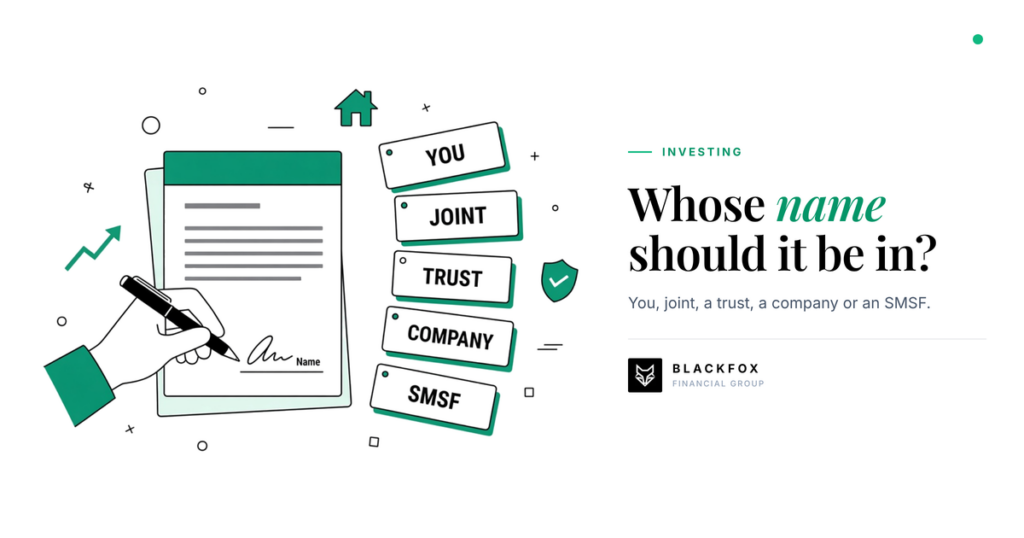
Investments: whose name should it be in?
Before you put money into a term deposit, shares, property or a managed fund, there’s one question that’s easy to skip: whose name should it be in? The answer can affect your tax for decades. Changing it later usually costs money, because moving an asset to someone else can trigger capital gains tax and, for property, stamp duty.
In this article we cover:
- your own name, joint names and a lower-earning spouse
- a family (discretionary) trust
- a company
- a self-managed super fund (SMSF)
- the capital gains tax changes from 1 July 2027 and the proposed trust tax from 1 July 2028
- what each option costs to run.
The examples use 2026–27 tax rates for Australian residents. They’re illustrative only and simplified, so please don’t act on them without talking to us.
Your own name or joint names
Your own name. This is the simplest option. All the income and capital gains are taxed at your marginal rate, and there’s nothing extra to set up or lodge.
Joint names. When an investment is held jointly, the income is split according to each person’s ownership share. For a joint bank account, the ATO presumes the money is owned equally (so 50/50 for two people) unless there’s evidence otherwise, such as one person contributing all the money and treating the interest as theirs.
A lower-earning spouse. If one partner earns much less, holding income-producing investments in their name can mean less tax. The catch is that it has to be genuine. Tax follows whoever really owns the money, not just whose name is on the account.
Worked example: $200,000 in the bank
Alex and Bianca have $200,000 to put in a term deposit. At an illustrative interest rate of 4.5%, that’s $9,000 of interest a year ($200,000 × 4.5%).
- Alex’s taxable income is $40,000 (marginal rate 15%).
- Bianca’s taxable income is $150,000 (marginal rate 37%).
The figures include the 2% Medicare levy and the low income tax offset (LITO). They assume both are Australian residents with private hospital cover (so no Medicare levy surcharge) and no other offsets or deductions.
All in Alex’s name. The interest takes Alex from $40,000 to $49,000, which crosses the $45,000 threshold. The first $5,000 is taxed at 15% and the next $4,000 at 30%. Alex’s LITO also falls from $575 to $265. Extra tax: $2,440 a year.
All in Bianca’s name. Bianca stays in the 37% bracket. Extra tax: $9,000 × 39% (37% + 2% Medicare) = $3,510 a year.
Joint names (50/50). Alex pays $990 extra on $4,500 and Bianca pays $1,755 extra on $4,500. Total: $2,745 a year.
So holding the money in Alex’s name saves $1,070 a year compared with Bianca’s name. Joint names save $765.
If Bianca earned $100,000 instead (marginal rate 30%): in Bianca’s name the extra tax would be $9,000 × 32% = $2,880. Alex’s name would save $440 a year, and joint names (Alex $990 + Bianca $1,440 = $2,430) would save $450. Joint names come out slightly ahead here, because Alex’s extra income pushes Alex into a higher bracket. The best option depends on the actual numbers.
Things to keep in mind:
- Ownership must be genuine. If Bianca provides the money and uses the interest as her own, the ATO can tax her on it, whatever name is on the account.
- Other things are affected. Higher taxable income can affect Centrelink and family payments, child support and other income tests.
- Control and relationships. Money in your partner’s name is legally theirs. Think about what happens if the relationship ends or something happens to them.
A family (discretionary) trust
How it works. A trust is a legal arrangement in which a trustee (a person or a company) holds investments for a group of beneficiaries, usually family members and sometimes a family company. The trust deed sets the rules, including who can benefit.
Each year the trustee decides how the trust’s income is shared among the beneficiaries. That decision (a trustee resolution) must be made by 30 June, or earlier if the deed says so. The trust itself generally doesn’t pay tax. Instead, each beneficiary pays tax on their share at their own rates. Any income that no beneficiary is entitled to by 30 June is taxed to the trustee at the top rate (45% plus the Medicare levy).
Worked example (illustrative only). A family trust earns $100,000 of net investment income. The trustee shares it out like this:
- Jo, the lower-earning spouse, has other income of $40,000 and receives $25,000. Jo’s taxable income becomes $65,000, a marginal rate of 30% plus the 2% Medicare levy. Extra tax: $7,800.
- Sam, an adult child (19) at uni, has other income of $5,000 and receives $35,000. Sam’s taxable income becomes $40,000, a marginal rate of 15% plus the Medicare levy. Extra tax: $3,495.
- A family company (a “bucket company”) receives $40,000. Because its income is all passive investment income, it isn’t a base rate entity and pays the 30% company rate: $12,000.
Total tax: $23,295.
Compared with one high earner. If the whole $100,000 were taxed to Jo’s partner, who already earns $150,000, $40,000 would be taxed at 37% and $60,000 at 45%, plus the Medicare levy. Extra tax: $43,800.
The difference is $20,505 a year. However, the company’s share is only taxed at 30% while it stays in the company. When it’s paid out as a dividend, the shareholders pay top-up tax at their own rates (see the company section below).
Important rules and risks:
- Children under 18. Most trust income going to minors is taxed at penalty rates: nil up to $416, 66% on the amount between $417 and $1,307, and 45% on the whole amount once it’s over $1,307. That’s why the example uses an adult child.
- The money must really benefit the beneficiary. Under section 100A, if a beneficiary is given a distribution but someone else gets the benefit (for example, the money flows back to the parents) and the arrangement reduces tax, the ATO can tax the trustee at the top rate.
- Family trust elections. Many trusts make a family trust election to access certain tax concessions. Once made, distributions outside the family group attract family trust distribution tax at 47%.
- Bucket companies and Division 7A. If the trust doesn’t actually pay the company its share, or the family uses that money, Division 7A can treat it as a loan or an unfranked dividend unless it’s paid, or put under a complying loan, by the required time.
- Costs. A trust has set-up costs, an annual trust tax return and record-keeping (see the compliance section below).
The proposed trust tax from 1 July 2028
What’s proposed. In the 2026–27 Budget, the Government announced a 30% minimum tax on discretionary trusts from 1 July 2028. The trustee would pay 30% tax on the trust’s taxable income. Individual beneficiaries would still declare their share but would get a non-refundable credit for the tax the trustee paid. Company beneficiaries wouldn’t get a credit.
Some trusts and income would be excluded, including fixed and widely held trusts, super funds, special disability trusts, deceased estates, charitable trusts, genuine testamentary trusts, primary production income and certain income of vulnerable minors. There would also be a three-year roll-over from 1 July 2027 to help people restructure out of discretionary trusts.
Status. This is not law yet. The Bills were introduced into Parliament on 14 October 2026 and have been referred to a Senate committee, which is due to report on 13 November 2026. The details may change.
What it would mean. Sharing income with low-income family members would lose most of its benefit, because the tax on trust income wouldn’t fall below 30%. Applying the draft rules to our example (using today’s rates):
- Jo: the trustee pays $7,500, Jo uses the credit in full, and the family pays $7,800 in total, the same as now. Jo’s own rate is already around 30%.
- Sam: the trustee pays $10,500. Sam’s credit can only reduce Sam’s own tax to nil, so $7,805 of it is wasted, and Sam still pays the $800 Medicare levy. The family pays $11,300, compared with $3,495 now.
- Bucket company: under the draft, the company gets no credit for the trustee’s $12,000 and pays its own $12,000 company tax, so $24,000 in total. In practice, most families would stop distributing to a bucket company.
On those draft numbers, the family’s total would be about $43,100, almost the same as the high earner paying it all ($43,800).
What still matters. The non-tax reasons for a trust don’t change: protecting assets, flexibility, and planning for the next generation. But a trust set up mainly to split income would be worth reviewing before 2028.
A company
How a company can cap or defer tax. A company pays tax at a flat rate. A company that earns mainly passive income, such as interest, dividends, rent or capital gains, generally isn’t a base rate entity and pays 30%. The 25% rate only applies to base rate entities, which need turnover under $50 million and no more than 80% passive income. An individual on a high income pays 37% or 45%, plus the Medicare levy.
Profits kept in the company are taxed only at the company rate. When they’re paid out as franked dividends, the shareholder includes the dividend and its franking credit in their tax return and pays top-up tax at their marginal rate. If their rate is lower than the company rate, they can generally get the difference refunded. The benefit is deferral, and the chance to pay dividends out in lower-income years, such as in retirement.
Worked example (illustrative only). An investor on the top rate earns $50,000 a year of investment income.
- In their own name: $50,000 × 47% (45% + 2% Medicare) = $23,500.
- Kept in a company: $50,000 × 30% = $15,000.
- Tax deferred: $8,500 a year, which stays invested.
If it’s paid out later: if the profit is paid out as a franked dividend while the investor is still on the top rate, they’d pay the $8,500 top-up then. If it’s paid out in retirement, when this dividend is their only income, the tax on $50,000 (the $35,000 cash dividend plus the $15,000 franking credit) is $6,270. The $15,000 franking credit covers that and leaves a refund of $8,730. Overall, the family pays $6,270 instead of $23,500.
Watch-outs:
- Division 7A. If company money is lent to, paid to or used by shareholders or their family, it can be treated as an unfranked dividend unless it’s handled correctly.
- Costs. A company has ASIC fees, a company tax return and financial statements (see below).
- No CGT discount. Companies can’t use the 50% CGT discount.
The capital gains tax changes from 1 July 2027
Today. Individuals and trusts can generally halve a capital gain on assets held for at least 12 months. Complying super funds get a one-third discount. Companies get no discount.
From 1 July 2027 (now law). For individuals, partnerships and trusts, the 50% discount will be replaced by indexation of the cost base for inflation, plus a 30% minimum tax on capital gains. The changes only apply to gains arising after 1 July 2027. Gains built up before then keep the 50% discount. People receiving means-tested income support payments, such as the Age Pension, are exempt from the minimum tax in a year they receive a payment. Investors in eligible new builds can choose between the old and new rules.
Negative gearing is also changing. For established homes bought after 7:30pm (AEST) on 12 May 2026, rental losses from 1 July 2027 can only be used against residential property income, not against wages. Unused losses can be carried forward. Properties held before that time aren’t affected.
Why this matters for companies. Companies never had the discount, and the Budget material describes indexation as applying to individuals, partnerships and trusts. It doesn’t mention companies, so this example assumes a company is still taxed on the full gain. With the discount gone and a 30% minimum tax on individuals’ gains, the gap between holding growth assets yourself and holding them in a company narrows.
Illustrative comparison: a $100,000 gain on an asset bought and sold after 1 July 2027.
- Before the change (50% discount), top-rate individual: $50,000 taxable × 47% = $23,500.
- After the change, if inflation accounts for $50,000 of the gain: $50,000 real gain × 47% = $23,500 (about the same).
- After the change, if inflation accounts for only $20,000: $80,000 real gain × 47% = $37,600.
- Company, before or after: $100,000 × 30% = $30,000.
So for strong-growth assets held by a top-rate taxpayer, a company may now pay less tax on the gain than an individual. Remember the company’s profit still faces top-up tax when it’s paid out as a dividend, and companies don’t pass any CGT discount on to shareholders. The minimum tax also means a lower-income person can no longer sell in a low-income year and pay much less than 30% on the gain.
An SMSF
So far we haven’t looked at super. For many people, a self-managed super fund (SMSF) is the most tax-effective place to invest, as long as you don’t need the money until retirement.
How SMSFs are taxed:
- Accumulation phase: fund income is taxed at 15%. Capital gains on assets held at least 12 months get a one-third discount, so they’re effectively taxed at 10%.
- Retirement phase: income from assets supporting a retirement-phase pension is generally tax-free. How much you can move into retirement phase is limited by the transfer balance cap, which is $2.1 million for people starting a pension from 1 July 2026. Your personal cap may differ.
- The 2027 CGT changes: the Budget material says super funds, including SMSFs, are excluded, so super funds keep their one-third discount.
- Large balances: from 1 July 2026 (now law), Division 296 adds an extra 15% tax on earnings linked to the part of a total super balance over $3 million, and a further 10% over $10 million.
Rules to know:
- Preservation. Money in super is generally locked away until you meet a condition of release, such as retiring after your preservation age.
- Contribution caps. There are limits on how much you can put in. For 2026–27 they’re $32,500 a year before tax and $130,000 a year after tax (more under the bring-forward rule if you’re eligible). You can’t simply move a large investment into super in one go.
- Sole purpose test. The fund must be run only to provide retirement benefits. You can’t use fund assets personally.
- Trustee duties. SMSF trustees are personally responsible for running the fund correctly, including having an investment strategy and an annual independent audit.
Worked example (illustrative only). $500,000 earns a total return of 7% a year, or $35,000. For simplicity, the whole return is treated as taxable income each year. The example ignores franking credits, CGT discounts and timing.
- Top-rate individual: $35,000 × 47% = $16,450 tax a year.
- SMSF accumulation phase: $35,000 × 15% = $5,250.
- SMSF retirement phase: $0.
Over 10 years, with after-tax returns reinvested:
- Individual: 7% × (1 − 0.47) = 3.71% a year. $500,000 grows to about $719,700.
- SMSF accumulation: 7% × (1 − 0.15) = 5.95% a year. $500,000 grows to about $891,200.
- SMSF retirement phase: 7% a year. $500,000 grows to about $983,600.
SMSFs generally suit people with larger balances who want control and are prepared to take on trustee duties. If you’re weighing up an SMSF, talk to us first.
What each option costs to run
Your own name or joint names
- What’s needed: include your share of the income and gains in your personal tax return.
- Government fees: none.
- Accounting fees: usually part of your normal tax return, and typical accounting costs vary.
Family trust
- What’s needed:
- a trust deed, plus an ABN if needed and a tax file number
- a separate bank account and records
- trustee resolutions by 30 June each year
- an annual trust tax return
- family trust election decisions.
- Government fees: no ASIC fee for the trust itself. If you use a company as trustee, that company pays an ASIC annual review fee ($342 for a proprietary company from 1 July 2026, or $70 if it’s a special purpose company whose only role is trustee).
- Accounting fees: for set-up and the annual accounts and return, typical accounting costs vary.
Company
- What’s needed:
- ASIC registration
- an annual review
- a director ID for each director
- financial statements
- an annual company tax return
- minutes and records
- Division 7A compliance.
- Government fees: ASIC company registration is $636, and the annual review fee is $342 for a proprietary company from 1 July 2026.
- Accounting fees: for set-up and the annual accounts and return, typical accounting costs vary.
SMSF
- What’s needed:
- a trust deed and fund registration
- a written investment strategy
- annual accounts with assets at market value
- an independent audit by an approved SMSF auditor
- an SMSF annual return
- trustee obligations, including keeping fund money separate.
- Government fees: the ATO SMSF supervisory levy is $259 a year ($518 in a new fund’s first return, covering two years). A corporate trustee that’s a special purpose company pays a $70 ASIC annual review fee.
- Accounting and audit fees: for set-up, the annual accounts and return, and the audit, typical accounting costs vary.
Talk to us before you buy, not after
The right structure depends on your income, family, goals and plans, and the rules are changing. A short conversation before you invest can save years of extra tax and costly restructuring.
Contact our team today or call us on 03 8910 8940.

Mike Carter
Managing Director
BLACKFOX Financial Group
This article contains general information only. It doesn’t take your personal circumstances into account and isn’t personal financial advice. Tax rules change, and this information is current as at October 2026. Please speak to us before acting on it.