
Payday Super Is Here: What Every Small Business Needs to Know
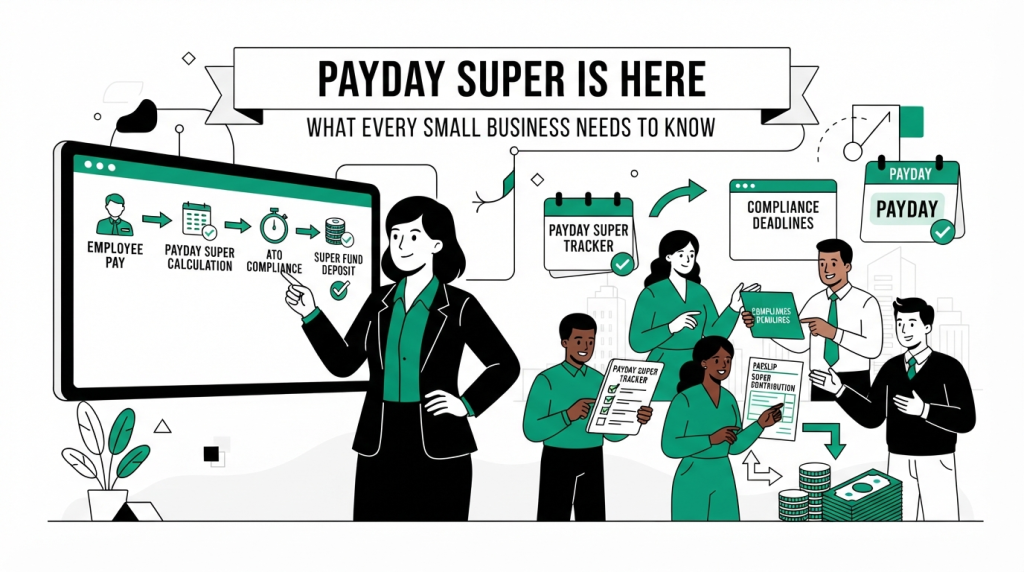
By Blackfox Financial Group
After years of consultation and legislative back-and-forth, Payday Super is now law. From 1 July 2026, the way you pay your employees’ superannuation has fundamentally changed — and if your business hasn’t adjusted its payroll processes yet, now is the time to act.
Here’s what’s changed, what you need to do, and what happens if you get it wrong.
What is Payday Super?
Under the old rules, employers could pay superannuation guarantee (SG) contributions quarterly, with payments due within 28 days of the end of each quarter. That meant an employee’s super could sit in the business’s bank account for up to four months before reaching their fund.
Payday Super changes that. For any payday on or after 1 July 2026, employers must pay super at the same time as salary and wages — and the contribution must actually be received by the employee’s super fund within 7 business days of payday.
A few key points to understand:
- The deadline is receipt, not payment. It’s not enough to process the payment within 7 business days — the money (along with the information the fund needs to allocate it) must land in the employee’s account within that window. You need to allow for clearing house and banking processing times.
- Super is now calculated on “Qualifying Earnings” (QE). This is a new term that brings together ordinary time earnings, commissions, salary sacrifice amounts and certain other payments. For most employees, the outcome will be similar to the old OTE calculation, but pay items need to be correctly classified in your payroll software.
- The SG rate hasn’t changed. It remains at 12%.
- New employees get extra time. The first contribution for a new employee (or a first payment to a new fund) has an extended deadline of 20 business days, allowing for onboarding and fund detail verification.
In practical terms: if you pay staff weekly, you’re now paying super weekly. Fortnightly payroll means fortnightly super. There’s no more quarterly catch-up.
What Small Businesses Need to Do
If you haven’t already made these changes, treat this as your action list:
1. Replace the Small Business Super Clearing House. The ATO’s free SBSCH closed on 30 June 2026. If you were relying on it, you need an alternative immediately — most payroll software (Xero, MYOB, QuickBooks) has an integrated super payment solution, and many super funds offer free clearing house access to their default employers.
2. Review your payroll software and pay items. Confirm your software is Payday Super ready and that every pay item is correctly flagged as Qualifying Earnings where SG applies. Misclassified allowances, bonuses or loadings are one of the easiest ways to create an accidental shortfall.
3. Align your super processing with every pay run. Super needs to become part of your standard payroll routine, not a quarterly task. Build the payment step into your pay run checklist so nothing is missed.
4. Check employee super fund details. Rejected payments due to incorrect member numbers or closed accounts can push you past the 7-business-day deadline. Now is the time to audit and clean up your employee super records.
5. Model the cash flow impact. This is the big one for many small businesses. Super that used to be held for up to four months now leaves your account every pay cycle. If you’ve been using accrued super as informal working capital, you need a new cash flow plan — and possibly a conversation with your accountant about funding the transition.
6. Consider the NPP. From 1 July 2026, all super funds must be able to receive contributions via the New Payments Platform, enabling near-instant transfers. Check whether your clearing house supports this — it gives you valuable breathing room within the 7-day window.
What Happens If You’re Late?
This is where the new regime has real teeth. The old quarterly Super Guarantee Charge (SGC) system has been replaced with something faster, more automated, and considerably more expensive to fall foul of.
If a contribution isn’t received by the fund within 7 business days of payday:
- The ATO assesses the charge — not you. Under the old system, employers self-assessed by lodging an SG statement. Now the ATO identifies shortfalls (largely through Single Touch Payroll data matched against fund reporting) and issues assessments directly.
- The new SGC includes notional earnings and an administrative uplift. You’ll pay the outstanding super, plus interest-style notional earnings to compensate the employee, plus an administrative uplift designed to encourage early voluntary disclosure. The uplift can be reduced if you come forward before the ATO takes action.
- Late payment can’t wipe the charge. Paying the outstanding super promptly will reduce the SGC, but it can no longer reduce it to nil — the notional earnings and uplift remain payable. The old “late payment offset” is gone.
- Penalties can reach 200% of the charge. Additional penalties of 25% or 50% of unpaid SGC apply depending on your history, with a maximum of 200% in serious cases.
- The SGC remains non-deductible. Every dollar of the charge is paid from after-tax profits, making late super one of the most expensive mistakes a small business can make.
The one piece of good news: the ATO has confirmed a facilitative approach for the first year (to 30 June 2027) under its practical compliance guideline. Employers making a genuine effort to pay super each payday — even with occasional hiccups like rejected payments that are fixed promptly — will be treated as low risk. But employers who simply continue paying quarterly, or who ignore the new rules altogether, are squarely in the ATO’s sights. Superannuation is also now part of the National Employment Standards, opening a second enforcement avenue through the Fair Work Ombudsman.
Don’t Navigate This Alone
Payday Super touches every part of your payroll — software configuration, pay item classification, super fund data, payment timing and cash flow. Getting it right from the start is far cheaper than fixing it after an ATO assessment.
At Blackfox Financial Group, our bookkeeping and payroll team can help you implement the changes — from setting up a new clearing house and reviewing your pay items, to managing your ongoing payroll and super compliance so every contribution lands on time, every pay run.
Whether you need a one-off Payday Super health check or fully managed payroll, we’d love to help.
Get in touch with our team today or call us on 03 8910 8940 to make sure your business is on the right side of the new rules.

Mike Carter
Managing Director
BLACKFOX Financial Group
This article contains general information only and does not constitute financial or tax advice. Please contact Blackfox Financial Group for advice tailored to your circumstances.