
Holiday Home Deductions Just Got Harder: The ATO’s New Rules Explained
By Blackfox Financial Group
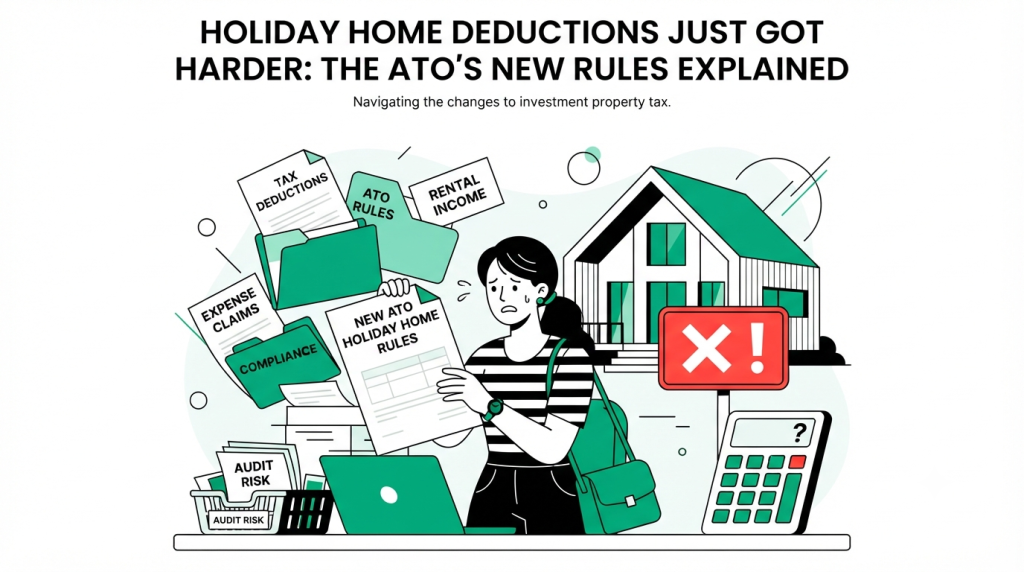
If you own a holiday home that you rent out for part of the year, the tax rules you’ve relied on for decades have just changed. From 1 July 2026, the ATO has fundamentally rewritten its approach to holiday home deductions through new Taxation Ruling TR 2026/1 and accompanying compliance guidelines (PCG 2026/2 and PCG 2026/3) — and for many of Australia’s estimated 250,000 rented holiday homes, the outcome will be far fewer deductions, or none at all.
Unlike the CGT and negative gearing reforms we’ve covered recently, this isn’t new legislation — it’s the ATO changing how it interprets and enforces the existing law. But the practical impact is just as significant, and it’s already in effect.
The Old Approach: Days Available = Deductions
For decades, the position was relatively simple. If your holiday home was genuinely available for rent, you could claim deductions for ownership costs — mortgage interest, council rates, insurance, repairs, depreciation — apportioned by the number of days the property was rented or available for rent versus used privately.
Crucially, “available for rent” carried a lot of weight. A property listed on a rental platform for most of the year could support substantial deductions even if actual bookings were sparse, as long as private use days were excluded.
The New Approach: What’s the Property Mainly For?
From 1 July 2026, the ATO asks a threshold question before any apportionment happens: is the property used, or held for use, mainly to produce rental income?
The answer determines everything:
- Yes — mainly income-producing: The standard rental property rules apply. Deductions are allowed, apportioned for any private use under the new apportionment guideline (PCG 2026/2).
- No — mainly for private holidays or recreation: The property is treated as a “leisure facility” under section 26-50 of the tax law, and most ownership deductions are denied entirely. No interest. No council rates. No land tax. No insurance. No repairs and maintenance. No depreciation.
Where a property is classified as a leisure facility, the only deductions that survive are expenses incurred directly in generating rental income — advertising fees, booking platform commissions, and cleaning costs for guest stays.
And here’s the sting: rental income remains fully taxable even where the deductions are denied. You can end up paying tax on your rental receipts while claiming almost nothing against them.
How the ATO Decides “Main Use”
This is where behaviour matters far more than paperwork. Simply listing your property on Airbnb or Stayz does not establish that it’s mainly held to produce income — the ATO looks at what actually happens. Under the new compliance guideline, arrangements are sorted into risk zones, and the factors that push you into the ATO’s sights include:
- Blocking out peak periods for personal use. If your family uses the property over Christmas, Easter or school holidays — precisely when a genuine rental would command the highest rates — the ATO is likely to conclude the property is a private holiday home first and a rental second.
- Advertising at unreasonably high rates, particularly during high-demand periods, in a way that deters actual bookings.
- Restrictive booking conditions — “no families”, “no pets”, minimum stays designed to discourage renters.
- Low actual occupancy relative to genuine availability, and prioritising personal use over income generation.
On the other side, the hallmarks of a low-risk, genuinely income-producing property include high income-producing occupancy (especially across peak seasons), market-rate pricing, year-round availability, active efforts to secure bookings, and minimal private use.
Consider two contrasting owners. An owner who lists their beach house year-round at market rates, keeps it available over summer, and takes one week privately in the off-season is squarely in “mainly income-producing” territory — normal rules, apportioned deductions. An owner who blocks out Christmas and school holidays for the family and picks up occasional off-season bookings is very likely holding a leisure facility — and their interest, rates, insurance and depreciation claims are gone.
Main Use Can Change — In Either Direction
The classification isn’t necessarily fixed forever. The ATO accepts that a property’s main use can change part-way through your ownership, or even part-way through an income year — for example, if you stop using the property personally and commit it genuinely to the rental market, deductions can become available from that point (with apportionment for any remaining private use).
Equally, normal seasonal patterns won’t flip your status — a ski lodge doesn’t change its “main use” just because the snow season ends — and a one-off use out of pattern won’t either. It’s the overall character of how the property is held that counts.
What This Means in Dollars
For a typical negatively geared holiday home with, say, $30,000–$50,000 a year in interest, rates, insurance and upkeep, losing ownership deductions transforms the asset’s economics entirely. Combined with the negative gearing changes passed by Parliament in June (which quarantine rental losses on established properties acquired after Budget night from 1 July 2027), the tax landscape for lifestyle property has shifted dramatically in the space of two months. Some commentators are already predicting downward pressure on holiday home values as owners re-run their sums.
It’s worth being clear about who isn’t targeted: genuinely commercial short-stay operators who run their properties for occupancy and returns are unaffected in substance — if your property is truly run as a rental business, the standard rules continue to apply.
What Holiday Home Owners Should Do Now
- Honestly assess your property’s main use. Look at your last two or three years of actual usage: who stayed, when, at what rates, and how much was personal or family use — especially across peak periods.
- Review your peak-season practices. If you want the property treated as income-producing, making it genuinely available at market rates over Christmas, Easter and school holidays is now close to non-negotiable.
- Fix your record-keeping. Keep clear records of listings, advertised rates, enquiries, bookings, knock-backs and private use. In a review, contemporaneous records will decide the outcome.
- Reprice the asset. If ownership deductions are off the table, model the true after-tax holding cost. For some families, the answer may be restructuring how the property is used; for others, it may prompt a conversation about selling — which then intersects with the new CGT rules commencing 1 July 2027, making the timing of any sale a genuine planning decision.
- Don’t assume last year’s tax return approach still works. The 2026–27 year, which has just begun, is the first year under the new ruling. Claims prepared on the old “days available” logic are exactly what the ATO will be reviewing.
Get Ahead of the ATO Review Activity
Holiday home deductions are now one of the ATO’s most clearly signposted compliance targets, and the new rules are highly fact-specific — the difference between full deductions and none can come down to how you handled a handful of peak-season weeks.
At Blackfox Financial Group, we can review your holiday home arrangements against the new ruling, assess your risk zone, restructure your rental practices and records where needed, and model whether holding or selling makes sense under the combined weight of the new deduction, negative gearing and CGT rules.
Contact our team today or call us on 03 8910 8940 for a holiday home tax review before you lodge your next return.

Mike Carter
Managing Director
BLACKFOX Financial Group
This article contains general information only and does not constitute financial or tax advice. The application of TR 2026/1 and PCG 2026/3 is highly dependent on individual facts and circumstances. Please contact Blackfox Financial Group for advice tailored to your situation.