
Legal Insight: Employee or Contractor? The Label Is Not Enough
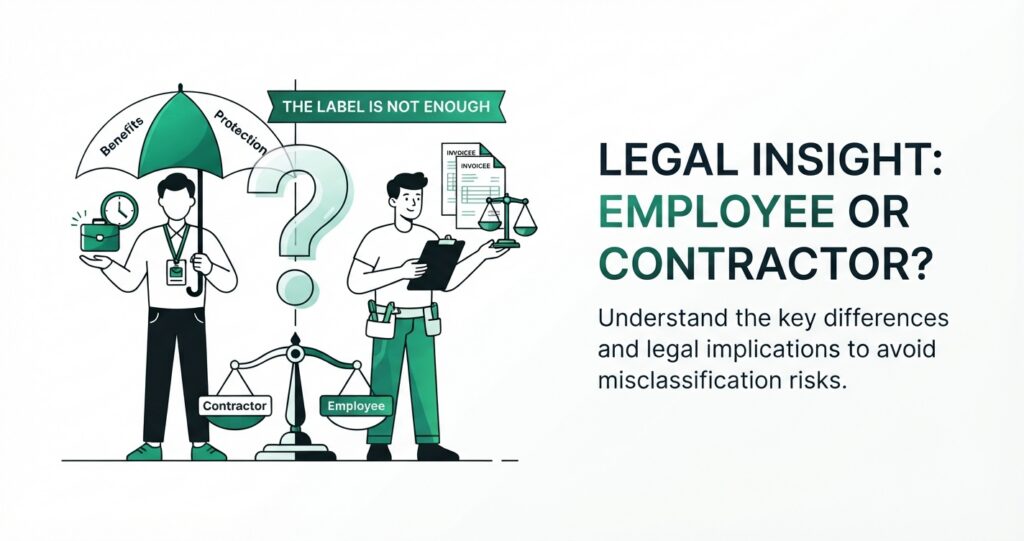
Calling someone a contractor does not make them one. Neither does requiring them to obtain an ABN, submit invoices, register for GST or sign a contractor agreement.
If the arrangement operates like employment, the worker may be an employee at law regardless of the label used. For a business, that can lead to claims for unpaid wages, leave, overtime, penalty rates, superannuation and other entitlements.
What Is the Basic Difference?
An employee generally works in and for the employer’s business. They usually perform the work personally, follow the employer’s directions and do not carry the commercial risk of running the business.
A contractor generally operates a business of their own. They are more likely to be engaged to deliver a result, control how the work is performed, provide their own equipment, carry financial risk and have the ability to delegate or subcontract the work.
The difficulty is that real working arrangements often sit somewhere between these two descriptions.
What Do the Courts Look At?
There is no single deciding factor. The relationship must be assessed as a whole.
For most incorporated businesses, the Fair Work Act requires consideration of the real substance, practical reality and true nature of the relationship. This includes the written contract and how the arrangement actually operates. Different tests can apply to sole traders, partnerships and under tax, superannuation and other legislation, so the contract matters.
The key issues are:
Control
Who decides when, where and how the work is performed? A worker who follows set hours, reports to a manager and works under detailed direction is more likely to be an employee. A contractor is more likely to decide how to achieve the agreed result.
Delegation
Must the worker perform the work personally, or can they genuinely send another suitably qualified person? Personal service points towards employment. A genuine ability to delegate or subcontract supports an independent contractor relationship.
Whose business is being operated?
Does the worker advertise to the public, quote for jobs, serve multiple clients and build goodwill of their own? Or are they presented as part of the engaging business, using its systems and performing the same ongoing role as its employees?
Financial risk and profit
Employees are usually paid for their time and do not bear the risk of a job costing more than expected. Contractors are more likely to quote a price, manage their costs, carry insurance, correct defective work at their own expense and profit from working efficiently.
Tools and equipment
Providing substantial tools, equipment or materials supports contracting. Using equipment supplied by the business supports employment, although this factor is less useful where the work requires little more than a phone or laptop.
Payment and continuity
Payment for a defined result is more consistent with contracting. Regular payment for hours worked, fixed working days and an ongoing expectation of work may point towards employment. However, none of these matters is conclusive on its own.
How a Contractor Arrangement Can Drift into Employment
Consider a person engaged as a contractor for a particular project. The project ends, but the person stays. They begin working fixed days, report to a manager, use the business’s equipment and systems, perform an ongoing internal role and are not genuinely free to delegate the work.
The contractor agreement and invoices remain unchanged, but the relationship has changed. For businesses subject to the whole of relationship test, what happens in practice can be just as important as what the agreement says.
This is why contractor arrangements should be reviewed when a worker’s role becomes longer-term, more regular or more integrated into the business.
Misclassification and Sham Contracting
Not every incorrect classification is deliberate sham contracting. A business can genuinely misunderstand the law and still be liable for unpaid employee entitlements.
Sham contracting is a separate issue. It may be unlawful to represent an employee as a contractor where the business does not reasonably believe the worker is a contractor. It is therefore important to assess the arrangement properly rather than relying on a standard contractor template.
Contractors May Still Be Entitled to Superannuation
Superannuation has its own rules. A genuine independent contractor may still be treated as an employee for superannuation purposes if they are engaged as an individual under a contract that is wholly or principally for their personal labour.
The risk is greater where the worker must perform the work personally, has no genuine right to delegate and is being paid mainly for their labour rather than to deliver a result involving substantial equipment or materials. Having an ABN and issuing invoices does not, by itself, remove the obligation to pay superannuation.
Practical Steps for Business Owners
Before engaging a contractor, a business should:
- assess the proposed relationship as a whole;
- use a written agreement that reflects the genuine arrangement;
- ensure day-to-day practices remain consistent with the agreement;
- review the arrangement if the worker’s role changes; and
- separately check employment, award, tax, superannuation, payroll tax and workers compensation obligations.
A contractor agreement can document a genuine contractor relationship. It cannot turn an employee into a contractor simply by saying so.
Final Thoughts
Contractors can provide valuable flexibility, but the arrangement must be genuine. A short review at the beginning, and again if the role changes, is usually far less expensive than dealing with years of unpaid entitlements after a dispute arises.
Contact our team today or call us on 03 8910 8940 to book a review.

Robert Belcher
Principal Lawyer
Robert Belcher Legal
Disclaimer: This article provides general information only and is not legal advice. Whether a worker is an employee or contractor depends on the particular circumstances and the law being applied. Specific advice should be obtained before acting on this information.