
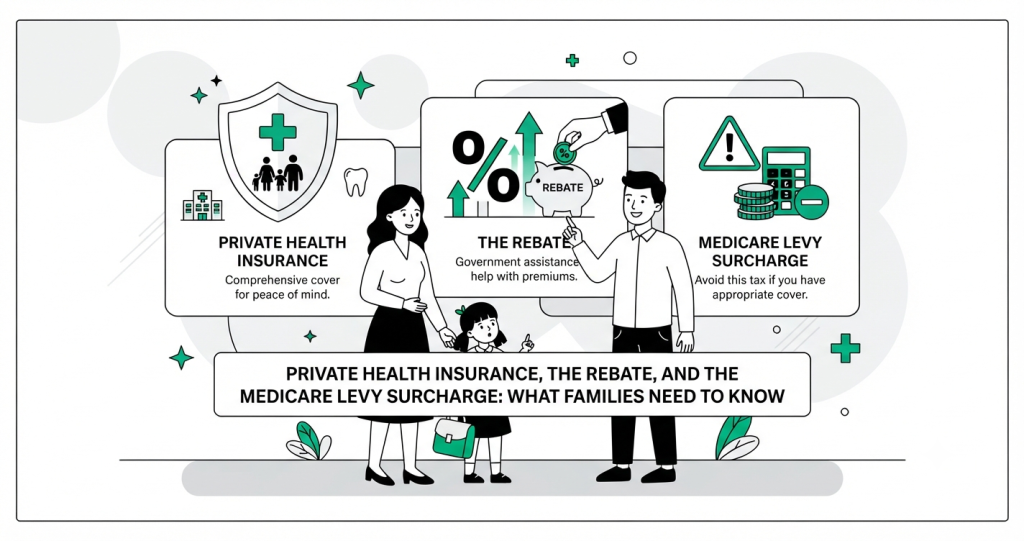
Private Health Insurance, the Rebate, and the Medicare Levy Surcharge: What Families Need to Know
If you’ve ever looked at your private health insurance premium and wondered why the “government rebate” line keeps shrinking every year, or why your accountant keeps asking about your spouse’s income when you thought you were the only one on the policy — this article is for you.
There are actually two separate things at play here, and they pull in opposite directions:
- The Private Health Insurance Rebate — a subsidy the government pays towards your premiums, which reducesas your income goes up.
- The Medicare Levy Surcharge (MLS) — an extra tax higher-income earners pay if they don’t hold private hospital cover, which increases your tax bill if you go without insurance.
Understanding both — and how family income is combined for each — is the key to making sure you’re not paying more than you need to.
The rebate is income-tested, not a flat percentage
The rebate isn’t a fixed discount everyone gets. It’s tiered against your income, and reduces in steps as you earn more. There are four tiers — Base, Tier 1, Tier 2 and Tier 3 — and your rebate percentage also depends on the age of the oldest person covered by the policy (older policyholders get a slightly higher rebate at every tier, in recognition that premiums and claims tend to be higher later in life).
For the 2025–26 income year, the tiers look like this:
| Family status | Base tier | Tier 1 | Tier 2 | Tier 3 |
|---|---|---|---|---|
| Single | $101,000 or less | $101,001 – $118,000 | $118,001 – $158,000 | $158,001 or more |
| Family | $202,000 or less | $202,001 – $236,000 | $236,001 – $316,000 | $316,001 or more |
And the rebate percentages (effective 1 April 2026 – 30 June 2026, and continuing through most of 2026–27) are:
| Age of oldest person on the policy | Base tier | Tier 1 | Tier 2 | Tier 3 |
|---|---|---|---|---|
| Under 65 | 24.118% | 16.079% | 8.038% | 0% |
| 65–69 | 28.139% | 20.098% | 12.058% | 0% |
| 70+ | 32.158% | 24.118% | 16.079% | 0% |
Once your income for surcharge purposes crosses the Tier 3 threshold, the rebate drops to zero entirely — you get no government contribution towards your premium at all. These thresholds are indexed and rise a little each year (for the 2026–27 year, the Tier 3 cut-off has moved up to $164,001 for singles and $328,001 for families), so it’s worth checking your entitlement annually rather than assuming last year’s tier still applies.
Why your family’s combined income matters
This is the part that catches people out. If you had a spouse on 30 June, or you’re a single parent with a dependent child, you’re not assessed against the single thresholds — you’re assessed against the family thresholds, using your combinedincome for surcharge purposes (broadly: taxable income, plus reportable fringe benefits, reportable super contributions, and net investment losses, added together for both of you).
So even if you personally earn well under $101,000, if your spouse earns enough to push your combined income past a tier boundary, your rebate entitlement drops for both of you — regardless of who’s actually named on the policy or who pays the premium.
A few practical points worth knowing:
- Each adult on a policy is tested separately on their own income, but the family thresholds still apply to each of them if they have a spouse or dependants — it’s their individual share of the premium that gets the family-tier rebate applied.
- Dependent children aren’t income tested at all. Their income doesn’t affect the family threshold, and they don’t need their own share of the rebate worked out.
- More children means a higher threshold. The family income threshold increases by $1,500 for each dependent child after the first — so a family with three children gets an extra $3,000 added to every tier boundary.
- Your status on 30 June is what counts, not your status for most of the year. If you separated during the year and are single with no dependants on 30 June, only your own income is used. If you had a spouse for even part of the year and still have one (or dependants) at year end, the family thresholds generally apply.
Because the rebate can be claimed either as an upfront premium reduction (nominated with your insurer based on an estimated income tier) or as a refundable tax offset at lodgment, getting the estimate wrong has real consequences. If your income turns out higher than expected — a bonus, a promotion, extra overtime — and you’ve been receiving a bigger premium reduction than you were entitled to, the ATO will claw it back as a liability on your notice of assessment. If it turns out lower, you’ll get a top-up offset. Either way, it reconciles at tax time, so it pays to keep your insurer updated if your circumstances change mid-year.
The other side of the coin: the Medicare Levy Surcharge
Here’s why maintaining private hospital cover is still worthwhile even once your rebate has reduced to nil (or never applied because your income sits above Tier 3): the Medicare Levy Surcharge.
The MLS is an additional tax — on top of the standard 2% Medicare levy — charged to higher-income individuals and families who don’t hold an appropriate level of private patient hospital cover for the full year. It uses the same income thresholds and the same combined-family-income approach as the rebate:
| Base tier | Tier 1 | Tier 2 | Tier 3 | |
|---|---|---|---|---|
| Single threshold | $101,000 or less | $101,001 – $118,000 | $118,001 – $158,000 | $158,001 or more |
| Family threshold | $202,000 or less | $202,001 – $236,000 | $236,001 – $316,000 | $316,001 or more |
| MLS rate | 0% | 1% | 1.25% | 1.5% |
The surcharge is calculated on your full taxable income (plus reportable fringe benefits), not just the amount over the threshold — so it adds up quickly. A couple with combined income for MLS purposes of $250,000 and no hospital cover would fall into Tier 2 and pay an extra 1.25% surcharge — around $3,125 for the year — purely for not holding a policy that would likely cost less than that in annual premiums.
This is the trap for higher-income families: your rebate may have shrunk to zero, but the reason to hold private hospital cover hasn’t gone away — it’s simply shifted from “get a subsidy” to “avoid a penalty.” For many families in Tier 2 or Tier 3, an appropriate hospital policy costs less than the surcharge it avoids, especially once you factor in extras cover you’d likely buy anyway.
A couple of nuances worth flagging:
- Extras-only cover doesn’t count. To avoid the MLS you need an appropriate level of hospital cover (with an excess of $750 or less for singles, $1,500 or less for families) for the whole income year. Ambulance-only or extras-only policies won’t exempt you.
- Part-year cover only gives part-year exemption. If you take out hospital cover partway through the year, you’ll still pay a pro-rata surcharge for the period you went without it.
- The MLS and the rebate are assessed independently. It’s entirely possible to be in a tier where your rebate has reduced to nil but you’d still be liable for the surcharge without cover — these aren’t mutually exclusive outcomes.
The bottom line
For most families, the practical takeaway is this: don’t judge the value of private health insurance purely by the size of the rebate you’re getting. As household income rises — particularly once a second income or a bonus pushes your combined income into Tier 1 or higher — the calculation shifts from “how much subsidy am I getting” to “how much surcharge am I avoiding.” Holding appropriate hospital cover can make sense at every income level, just for different reasons depending on where you sit.
If you’re not sure which tier your family falls into, whether your policy meets the hospital cover requirements, or whether it’s time to update your income estimate with your insurer, it’s worth checking before your premiums or your tax return reconcile in a way you weren’t expecting.
Get in touch with our team today or call us on 03 8910 8940 to make sure your business is on the right side of the new rules.

Mike Carter
Managing Director
BLACKFOX Financial Group
This article is general information only and doesn’t take into account your personal circumstances. Get in touch with the team at Blackfox Financial Group if you’d like this applied to your specific situation.